

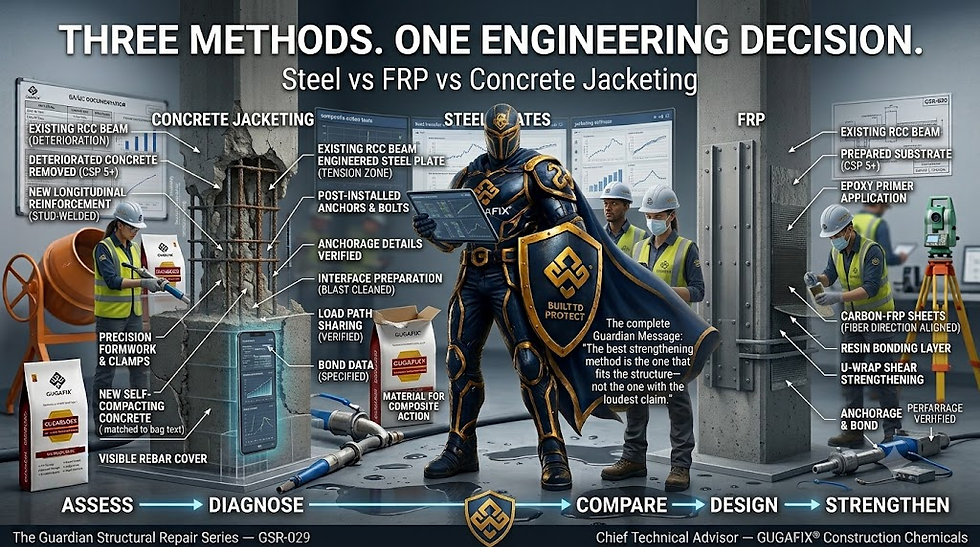
GSR-029 Steel vs FRP vs Concrete Jacketing: How Should Engineers Choose? The Guardian Structural Repair Series
By The Guardian
Chief Technical Advisor — GUGAFIX® Construction Chemicals
Introduction
There is rarely one universal method for strengthening an existing RCC structure.
When a beam, column or other structural member requires strengthening, engineers may consider several approaches, including:
Concrete jacketing
Steel plate strengthening
Fiber Reinforced Polymer (FRP) systems
Each method has different characteristics.
The right choice depends not simply on which material is strongest, cheapest or newest, but on the structural deficiency, existing condition, required capacity, geometry, access, durability, fire requirements, constructability and project objectives.
That is why the correct question is not:
“Which strengthening material is best?”
It is:
“Which strengthening system is most appropriate for this structure and this deficiency?”
The Guardian's Philosophy “I don't sell construction chemicals. I help people build stronger, safer, and longer-lasting structures.”
1. Start With the Structural Problem — Not the Material
Before selecting a strengthening method, the engineer should establish:
What has gone wrong?
Possible reasons include:
Increased structural loading
Change in building use
Original design inadequacy
Construction deficiencies
Concrete deterioration
Reinforcement corrosion
Damage
Seismic requirements
Structural modifications
Loss of load-carrying capacity
The strengthening method should then be selected to address the identified deficiency.
A material-first approach can result in an expensive strengthening system that does not properly address the actual structural problem.
2. The Three Major Approaches
A. Concrete Jacketing
Concrete jacketing involves adding a new reinforced concrete layer around an existing structural member.
Depending on the design, it can increase:
Cross-sectional dimensions
Longitudinal reinforcement
Transverse reinforcement
Load-carrying capacity
Confinement
It can be particularly useful where substantial strengthening or rehabilitation is required.
Strengths
Familiar construction methodology
Can provide significant increase in structural capacity
Can address heavily deteriorated members when properly designed
Can accommodate additional reinforcement
Suitable for substantial structural interventions
Limitations
Increases member dimensions
Adds dead load
Requires formwork and concrete placement
Can affect usable space
Generally involves greater site disruption
Interface between old and new concrete is critical
3. Steel Plate Strengthening
Steel plates can be externally installed to increase the capacity of an existing member.
Depending on the structural design, steel may be used for flexural or shear strengthening and other strengthening arrangements.
Strengths
High strength and stiffness
Established engineering practice
Can provide substantial strengthening
Suitable for situations where a relatively compact strengthening solution is required
Limitations
Steel is heavy compared with FRP
Handling and installation can be demanding
Corrosion protection is necessary
Connection and anchorage details are critical
Welding may introduce additional site considerations
Fire protection may need consideration depending on the system and building requirements
Steel strengthening is therefore not simply a matter of bonding a plate to concrete.
The connection is part of the structural system.
4. FRP Strengthening
FRP systems use high-strength fibers embedded in a polymer matrix.
Common fiber types include:
Carbon
Glass
Aramid
For RCC strengthening, FRP can be configured for applications such as flexural strengthening, shear strengthening and confinement, subject to engineering design.
Strengths
Very low added weight
Minimal increase in member dimensions
Easy handling compared with steel
Potentially rapid installation
FRP itself is not susceptible to corrosion in the same way as steel
Limitations
Bond to the concrete substrate is critical
Existing concrete condition can limit performance
Anchorage and debonding require careful consideration
Fire performance requires specific assessment
Installation is sensitive to system requirements and site conditions
It is not appropriate for every structural deficiency
The important point is:
FRP's high tensile strength does not eliminate the need for sound concrete, proper bonding and engineering design.
5. Side-by-Side Comparison
Consideration | Concrete Jacketing | Steel Plates | FRP |
Added weight | High | Moderate | Very low |
Increase in member dimensions | High | Low–moderate | Generally very low |
Installation handling | More demanding | Heavy | Relatively easy |
Site disruption | High | Moderate | Generally lower |
Structural capacity increase | Potentially substantial | Potentially substantial | Application-dependent |
Corrosion concern | Reinforcement requires protection | Steel requires protection | FRP itself does not corrode like steel |
Bond/interface | Critical | Critical | Highly critical |
Anchorage | Important | Critical | Critical |
Fire considerations | Generally favourable | Requires assessment/protection | Requires particular attention |
Access requirements | Higher | Moderate | Often favourable |
Suitable for major section enlargement | Yes | Limited | No |
Suitability for lightweight strengthening | No | No | Yes |
This table is a general engineering comparison. Actual suitability must be established through project-specific design.
6. When Concrete Jacketing May Be Preferred
Concrete jacketing may become attractive when:
Significant strengthening is required
Existing concrete is extensively deteriorated
Additional reinforcement is required
Member enlargement is acceptable
Increased confinement is required
A substantial structural rehabilitation intervention is planned
However, the engineer must account for the interaction between the existing member and the new jacket.
The new concrete must not simply surround the old member—it must participate structurally as designed.
7. When Steel Plates May Be Preferred
Steel strengthening may be considered when:
High strength and stiffness are required
A relatively compact strengthening arrangement is desirable
Suitable steel connection/anchorage details can be achieved
Site access permits handling and installation
Corrosion protection can be properly maintained
The design should consider the complete load path:
Existing structure → connection/bond → steel → anchorage → structural system
8. When FRP May Be Preferred
FRP can be particularly attractive where:
Added structural weight should be minimized
Increasing member dimensions is undesirable
Access is restricted
Rapid installation is important
Corrosion resistance is valuable
Targeted strengthening is required
But the substrate and environmental conditions must be suitable for the selected system.
9. What About Cost?
Cost should not be judged only by the price of the strengthening material.
The actual project cost can include:
Material
Surface preparation
Concrete repair
Formwork
Scaffolding/access
Lifting and handling
Labour
Connection/anchorage
Corrosion protection
Fire protection
Curing
Traffic or operational disruption
Inspection and testing
Future maintenance
Therefore, the cheapest material per kilogram—or even per square metre—may not produce the lowest overall project cost.
The Guardian's Advice
Compare the total installed strengthening system, not merely the material price.
10. Durability Must Be Considered
A strengthening system should be evaluated over the expected service life of the structure.
Engineers should consider:
Moisture
Chlorides
Carbonation
Chemical exposure
Temperature
Corrosion
UV exposure where relevant
Protection systems
Maintenance requirements
A strengthening method that performs well initially but cannot be adequately protected in the actual environment may not be the best long-term choice.
11. Fire Performance Cannot Be Ignored
This is particularly important when comparing steel, concrete and polymer-based FRP systems.
The strengthening system's behaviour under elevated temperatures should be evaluated according to the applicable design requirements.
For FRP systems especially, engineers should not assume that normal-temperature structural capacity automatically translates into adequate fire performance.
Where required, an appropriate protection system or alternative strengthening strategy may need to be considered.
12. Constructability Can Decide the Outcome
A technically excellent design can still become a poor project if it cannot be practically installed.
Ask:
Can workers access the member?
Can materials reach the work area?
Is there sufficient working clearance?
Can formwork be installed?
Can steel plates be safely handled?
Can FRP be installed under the required environmental conditions?
Can the work be completed without unacceptable disruption?
Can quality be inspected after installation?
Design and constructability must work together.
13. A Practical Selection Framework
The Guardian recommends this sequence:
Step 1 — Assess
Determine the existing structural condition.
Step 2 — Diagnose
Identify the cause and type of deficiency.
Step 3 — Quantify
Determine the required additional capacity or performance.
Step 4 — Define Constraints
Consider:
Space + Access + Weight + Fire + Environment + Construction Time + Budget
Step 5 — Develop Alternatives
Consider suitable strengthening methods.
Step 6 — Compare Complete Systems
Evaluate:
Structural performance + Durability + Constructability + Lifecycle cost
Step 7 — Select
Choose the method that best satisfies the engineering requirements.
Step 8 — Execute & Verify
Control installation quality and verify the completed strengthening.
14. A Simple Decision Matrix
Project Requirement | Potentially Favourable Option |
Major section enlargement acceptable | Concrete Jacketing |
Significant strengthening required | Concrete Jacketing / Steel |
High stiffness requirement | Steel / Concrete |
Very low added weight | FRP |
Minimal dimensional increase | FRP / Steel |
Difficult material handling/access | FRP |
Extensive concrete deterioration | Concrete Jacketing may be considered |
Corrosion-sensitive environment | FRP may offer an advantage |
Fire constraints are dominant | Concrete/Steel may have advantages depending on design |
Rapid targeted strengthening | FRP may be attractive |
This is a preliminary selection framework—not a substitute for structural design.
15. The Most Important Lesson
There is no universally “best” strengthening material.
Concrete jacketing is not outdated.
Steel plates are not obsolete.
FRP is not automatically superior because it is newer.
Each technology has a place.
The engineer's responsibility is to understand the existing structure and select the system that provides the required performance safely and economically.
The Guardian's Site Check
Before approving a strengthening method, ask:
1. What exactly is the structural deficiency?
2. Why did the deficiency occur?
3. What additional capacity is required?
4. Is the existing concrete suitable for the proposed intervention?
5. What is the complete load-transfer mechanism?
6. Can the proposed system actually be installed correctly on site?
7. What are the fire and durability requirements?
8. What protection and maintenance will be required?
9. What is the total installed and lifecycle cost?
10. Has the selected system been designed and detailed by the responsible structural engineer?
If these questions are answered properly, material selection becomes an engineering decision rather than a product preference.
Conclusion
Concrete jacketing, steel plates and FRP can all play important roles in RCC structural strengthening.
The best solution is not determined by the material's marketing claim.
It is determined by:
Structural deficiency + Existing condition + Required performance + Site constraints + Durability + Fire + Constructability + Lifecycle cost
That is the foundation of responsible structural rehabilitation.
The Guardian's Final Advice
“Don't choose the strongest material. Choose the right strengthening system for the structure, the deficiency and the conditions in which it must perform.”
About The Guardian
The Guardian — Chief Technical Advisor, GUGAFIX® Construction Chemicals
“I don't sell construction chemicals. I help people build stronger, safer, and longer-lasting structures.”
Knowledge Builds Stronger Structures
/blog/steel-vs-frp-vs-concrete-jacketing
#GUGAFIX #TheGuardian #StructuralEngineering #StructuralStrengthening #StructuralRehabilitation #RCC #RCCBeam #ConcreteJacketing #SteelPlateStrengthening #FRPStrengthening #FRP #StructuralRepair #CivilEngineering #ConstructionEngineering #InfrastructureRehabilitation #GuardianStructuralRepairSeries


Comments