

The Guardian Structural Repair Series —GSR-011 Micro Concrete vs Structural Repair Mortar: Which One Should You Choose?
Updated: Sep 14
Understanding the Difference Between Flowable Repair Materials and Hand-Applied Repair Mortars
By The Guardian - Chief Technical Advisor of GUGAFIX® Construction Chemicals
The Question Engineers and Contractors Often Ask
When concrete is damaged, one of the first decisions is:
Should we use Micro Concrete or a Structural Repair Mortar?
The answer is not simply:
"Micro Concrete is stronger."
Nor is it:
"Repair Mortar is easier."
The correct choice depends on the repair geometry, depth, access, substrate condition, reinforcement congestion, placement method and project specification.
Both materials can have an important role in concrete rehabilitation—but they are not interchangeable.
First, Understand the Basic Difference
Micro Concrete
Generally formulated as a flowable cementitious repair material intended for applications where the material needs to flow into a defined repair zone, often with suitable formwork.
Structural Repair Mortar
Generally formulated as a repair mortar that can be applied to prepared concrete surfaces, often by hand or suitable mechanical application methods depending on the product.
The difference is therefore not merely the name of the product.
It is fundamentally about:
HOW THE MATERIAL IS INTENDED TO BE PLACED.
1. Where Micro Concrete Can Be Advantageous
Micro Concrete can be particularly useful where the repair geometry makes conventional hand application impractical.
Examples can include:
Deep repair zones
Confined areas
Areas with significant reinforcement congestion
Larger-volume reinstatement
Repairs requiring formwork
Certain column rehabilitation applications
Its flow characteristics can help the material reach areas that may be difficult to access manually.
But the material must be selected according to its technical specification and intended application.
2. Where Structural Repair Mortar Can Be Advantageous
Repair Mortars can be appropriate where the repair is accessible for direct application.
Examples can include:
Localized concrete defects
Surface deterioration
Edge repairs
Vertical repairs
Overhead repairs, where the product is specifically designed for that application
Repairs where formwork is unnecessary
The specific application limits always depend on the individual product.
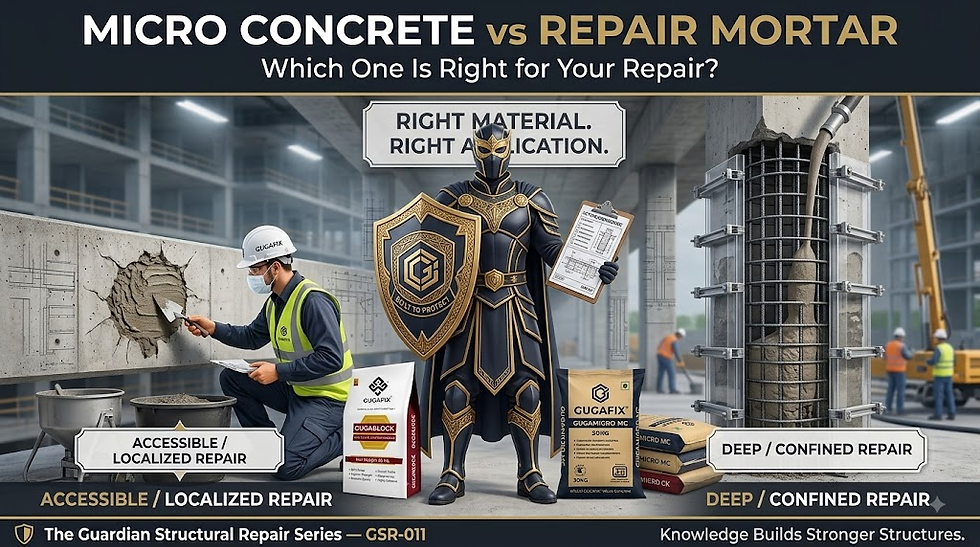
The Real Decision: Repair Geometry
This is one of the most useful ways to think about the choice.
SMALL / ACCESSIBLE REPAIR
If the damaged area is relatively accessible and can be directly built up:
Structural Repair Mortar may be appropriate.
DEEP / CONFINED REPAIR
If the repair is deep, confined or difficult to reach manually:
A suitable Micro Concrete may offer a better placement solution.
But this is not a universal rule.
The product Technical Data Sheet and project methodology remain the deciding references.
Micro Concrete vs Structural Repair Mortar
Consideration | Micro Concrete | Structural Repair Mortar |
Typical consistency | Flowable | Plastic / trowel able depending on product |
Typical placement | Pourable / flow placement | Hand or mechanical application depending on product |
Formwork | Often required for deep/formed repairs | Usually not required for accessible repairs |
Deep repairs | Often suitable where specified | Product-dependent |
Confined geometry | Potentially advantageous | May be difficult depending on access |
Localized surface repair | May be unnecessary | Often practical |
Vertical application | Depends on system | Many products designed for this |
Overhead application | Product-specific | Product-specific |
Large-volume reinstatement | Potentially suitable | Product-dependent |
Application method | Material-specific | Material-specific |
Important: This table is a general comparison. Actual application suitability must always be confirmed from the specific product's Technical Data Sheet.
3. Don't Choose Based Only on Compressive Strength
This is one of the biggest mistakes in repair-material selection.
Suppose:
Material A = higher compressive strength
and
Material B = lower compressive strength
That does not automatically make Material A the better repair material.
You must also consider:
Bond
Dimensional stability
Workability
Application thickness
Modulus/compatibility considerations
Shrinkage behavior
Durability
Permeability
Placement method
Curing requirements
The best repair material is not necessarily the strongest material.
It is the material that is appropriate for the repair system.
4. What Happens If You Choose the Wrong Material?
Example 1 — Deep Confined Repair
Trying to manually pack a conventional repair mortar into a deep, heavily reinforced cavity can make complete filling difficult.
Potential concern:
Voids or incomplete filling.
A suitably specified flowable repair material may be more appropriate.
Example 2 — Small Surface Defect
Using a flowable Micro Concrete system with extensive formwork for a small, accessible surface repair may unnecessarily complicate the work.
A suitable repair mortar could be more practical.
Example 3 — Overhead Repair
A flowable material is not automatically suitable simply because it is strong.
For overhead repairs, the product must specifically be suitable for the intended application and placement method.
5. Substrate Preparation Still Matters
Changing from Micro Concrete to Repair Mortar does not eliminate the need for proper preparation.
The substrate must be prepared according to the approved repair methodology.
Depending on the system, this may involve:
Removing unsound concrete
Cleaning the surface
Removing dust and contaminants
Preparing exposed reinforcement
Achieving the required substrate condition
Remember:
The repair material cannot compensate for a defective substrate.
6. Water Control Still Matters
Whether you are using Micro Concrete or Repair Mortar:
Do not add uncontrolled water.
The manufacturer's specified mixing procedure should be followed.
Adding extra water simply because the material appears difficult to work with can alter the intended properties of the repair system.
If workability is a problem, investigate:
Water measurement
Mixing procedure
Equipment
Material condition
Ambient conditions
Application methodology
7. Curing Still Matters
A common misconception is that only Micro Concrete requires careful curing.
That is incorrect.
Cementitious repair materials require appropriate curing and protection according to their specific technical requirements.
Therefore:
Micro Concrete → correct curing
Repair Mortar → correct curing
The exact procedure depends on the product.
8. What About Structural Repairs?
This is where we need to be particularly careful.
The term "structural repair mortar" does not automatically mean that every repair mortar is suitable for every structural application.
Similarly, the term "Micro Concrete" does not automatically make a product suitable for structural strengthening.
For structural applications, evaluate:
Structural requirement + product specification + compatibility + application method + project methodology
The responsible engineer should determine or approve the repair system where structural performance is involved.
The Guardian's Decision Framework
Before choosing the material, ask these seven questions:
1. How deep is the repair?
2. How accessible is the repair area?
3. Is reinforcement heavily congested?
4. Is formwork practical?
5. Can the material be properly placed in the geometry?
6. What performance does the project require?
7. Does the product Technical Data Sheet specifically support the intended application?
If you cannot answer these questions, you are not ready to select the repair material.
The Simple Rule
Choose a suitable Structural Repair Mortar when:
The repair is accessible and the product is designed for the required application method and thickness.
Consider a suitable Micro Concrete when:
The repair geometry, volume, access and placement requirements call for a flowable cementitious repair system.
But remember:
Application determines material selection—not the other way around.
GUGAFIX® Micro Concrete
GUGAFIX® Micro Concrete is developed for professional concrete repair and rehabilitation applications using carefully selected cementitious materials, graded aggregates, admixtures and German-origin specialty polymers.
It should be evaluated against the requirements of the particular repair rather than selected simply because it is a Micro Concrete.
For every project, refer to:
Technical Data Sheet + Project Specification + Structural Design + Approved Repair Methodology
The Guardian's Site Checklist
Before selecting the repair material:
Identify the cause of deterioration
Measure the repair area
Determine repair depth
Assess accessibility
Check reinforcement congestion
Determine whether formwork is practical
Define required performance
Review product Technical Data Sheet
Confirm application suitability
Establish mixing and curing procedure
Only then:
SELECT THE MATERIAL.
Frequently Asked Questions
Is Micro Concrete better than Structural Repair Mortar?
Neither is universally better. They are designed for different application conditions.
Can Structural Repair Mortar be used for deep repairs?
Some products can be used for specific thicknesses or build-up applications. Always follow the individual product's Technical Data Sheet.
Can Micro Concrete be used without formwork?
That depends on the product and application. Flowable Micro Concrete is commonly used with a defined repair zone/formwork for deep or formed repairs, but the manufacturer's instructions should be followed.
Which one is stronger?
That cannot be answered by product category alone. Compare the actual technical properties of the specific products.
Can either material be used for structural strengthening?
Not automatically. Structural strengthening requires engineering design and a repair/strengthening system appropriate to the project.
The Guardian's Advice
"Don't ask which repair material is better. Ask which repair material is right for the job."
— The Guardian, Chief Technical Advisor of GUGAFIX® Construction Chemicals
"I don't sell construction chemicals. I help people build stronger, safer, and longer-lasting structures."
The Guardian Structural Repair Series
Foundation Series
GSR-001 — Why Engineers Choose Micro Concrete for Structural Repairs
GSR-002 — Micro Concrete vs Conventional Concrete
GSR-003 — 10 Common Mistakes During Micro Concrete Repairs
GSR-004 — Why Surface Preparation Is Critical Before Micro Concrete Repairs
GSR-005 — How to Repair RCC Columns Using Micro Concrete
GSR-006 — How to Repair Honeycombs in Concrete Structures
GSR-007 — Why Non-Shrink Micro Concrete Matters
GSR-008 — Structural Repair Quality Control Checklist
GSR-009 — Common Structural Repair Failures
GSR-010 — The Complete Guide to Micro Concrete
Advanced Series
GSR-011 — Micro Concrete vs Structural Repair Mortar: Which One Should You Choose?
Next
GSR-012 — How to Select the Right Structural Repair Material for Different Repair Depths
This next article will go deeper into repair depth, layer thickness, build-up, accessibility and application method rather than repeating today's material comparison.
#Gugafix #TheGuardian #MicroConcrete #RepairMortar #StructuralRepair #ConcreteRepair #ConcreteRehabilitation #RCCRepair #StructuralEngineer #CivilEngineer #QAQC #SiteEngineer #ConstructionChemicals #Contractor #ProjectManager #Infrastructure #BuildingMaterials #ModernConstruction #ConstructionKnowledge #BuildingTheFuture


Comments