

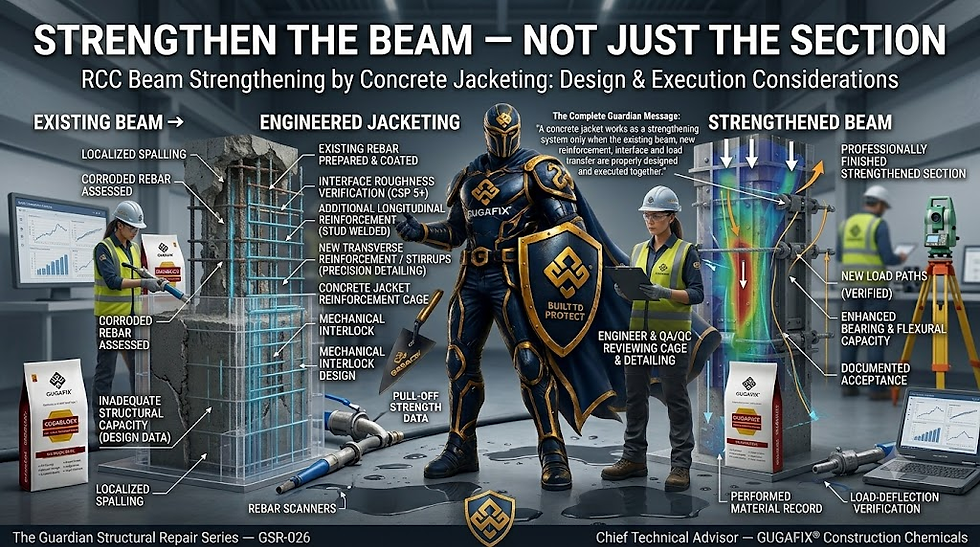
The Guardian Structural Repair Series — GSR-026RCC Beam Strengthening by Concrete Jacketing: Design and Execution Considerations
A Practical Guide to Assessing, Designing and Executing Concrete Jacketing for Existing RCC Beams
By The Guardian
Chief Technical Advisor
GUGAFIX® Construction Chemicals
Introduction
Concrete jacketing is one of the established methods used for strengthening existing reinforced concrete beams.
The basic concept is straightforward:
An existing RCC beam is enlarged by adding new concrete and additional reinforcement so that the strengthened member can achieve the structural performance required by the design.
But the execution is far more complicated than simply adding concrete around an existing beam.
A properly designed beam jacket must address:
Existing structural condition
Required additional capacity
Additional reinforcement
Anchorage
Interface between old and new concrete
Load transfer
Jacket geometry
Construction sequence
Material selection
Quality control
Final verification
Research on jacketed RC beams has demonstrated that reinforcement detailing, surface preparation and the connection between the existing beam and the jacket can significantly influence strengthening performance.
And this is exactly why:
Concrete jacketing is a structural system—not simply a concrete application.
The Guardian's First Rule
"Before adding a jacket to an existing beam, understand what the beam needs to carry, how much additional capacity is required, and how the new system will transfer that capacity."
1. Why Would an RCC Beam Need Jacketing?
Concrete jacketing may be considered when an existing beam requires additional structural capacity or rehabilitation.
Possible reasons include:
Increased imposed loads
Change in building use
Original design deficiencies
Deterioration of concrete
Reinforcement corrosion
Loss of structural section
Damage caused by an external event
Structural modifications
Changes in required performance
The first step should therefore be assessment, not material selection.
ACI's current repair framework treats assessment, repair and rehabilitation as an integrated engineering process and specifically includes structural design, bond, strengthening, temporary works, testing and quality assurance.
2. Repair or Strengthening?
This distinction must be established before jacketing begins.
If a beam has localized concrete deterioration but retains adequate structural capacity, the project may require repair.
If the beam does not have adequate required capacity, the project may require strengthening.
Sometimes both are required.
For example:
Deteriorated beam
↓
Remove unsound concrete
↓
Treat underlying deterioration
↓
Reinstate damaged section
↓
Add designed strengthening
That is a rehabilitation project involving both repair and strengthening.
We covered this distinction in GSR-022 — Structural Repair vs Structural Strengthening.
3. Assess the Existing Beam
Before designing a jacket, the existing beam must be understood.
Depending on the project, assessment may consider:
Beam dimensions
Existing reinforcement
Concrete condition
Cracks
Spalling
Corrosion
Existing loads
Previous modifications
Beam-column connections
Available structural drawings
Site investigation findings
The objective is to establish the existing structural condition and capacity.
You cannot design an effective strengthening system for a structure you have not properly assessed.
4. Establish the Structural Deficiency
The engineer must determine what is inadequate.
The deficiency could relate to:
Flexure
The beam requires greater bending capacity.
Shear
The beam requires greater shear capacity.
Stiffness
Excessive deflection or deformation may need to be addressed.
Durability
Deterioration may have reduced the effective structural section or reinforcement condition.
Combined Deficiency
More than one issue may exist simultaneously.
The strengthening design should respond to the actual deficiency.
5. Determine the Required Jacket
Once the structural requirement is established, the design determines the jacket configuration.
This can involve:
Jacket thickness
Added beam width
Added beam depth
Longitudinal reinforcement
Transverse reinforcement
Anchorage
Connection details
Concrete or cementitious material requirements
There is no universal jacket thickness that can be applied to every RCC beam.
The required dimensions and reinforcement are design parameters.
6. Reinforcement Is Fundamental
Concrete jacketing is not simply:
Existing beam + more concrete.
It is generally:
Existing beam + engineered reinforcement + new cementitious/concrete section + designed connection/interface.
Additional reinforcement may include:
Longitudinal bars
Stirrups
U-bars
Anchorage reinforcement
Other project-specific reinforcement
Experimental work on jacketed beams has highlighted the importance of adequate anchorage and reinforcement detailing, particularly for additional longitudinal and transverse reinforcement.
7. The Interface Between Old and New Concrete
This is one of the most critical aspects of concrete jacketing.
The existing concrete surface may require appropriate preparation to achieve the intended interaction between the old member and new jacket.
Depending on the design and material system, preparation may involve:
Removal of unsound concrete
Cleaning
Removal of contaminants
Surface roughening or profiling
Proper substrate conditioning
The objective is not simply to make the surface look rough.
The objective is to establish the interface required by the designed strengthening system.
Research on jacketed RC beams has specifically investigated the relationship between surface roughness, bond and strengthening performance.
8. Load Transfer Is Critical
This is where many superficial strengthening explanations fail.
The new jacket may be stronger than the old concrete.
But that alone does not guarantee that the strengthened beam will perform as intended.
The structural system must provide an effective mechanism for transferring forces between:
Existing Beam
↓
Interface / Connection
↓
New Reinforcement and Jacket
The engineer must establish how the additional structural capacity is developed.
Strong material does not compensate for poor load transfer.
9. Consider the Beam-Column Connection
A beam does not work alone.
Its ends connect to:
Columns
Walls
Slabs
Other beams
When a beam is strengthened, the forces entering and leaving the member can change.
Therefore, the strengthening design should consider the connected structural system.
Particularly important questions include:
Can the additional reinforcement be properly anchored?
Can the existing connection accommodate the strengthened beam?
Does the strengthening alter the load path?
Are adjacent elements adequate?
This is one reason why beam strengthening should not be designed as an isolated construction detail.
10. Three-Sided or Four-Sided Jacketing?
The available access can influence the strengthening configuration.
Four-sided jacketing
Where access permits, the beam may be strengthened around multiple faces.
This can provide more freedom for reinforcement and section enlargement.
Three-sided jacketing
Where the beam is integrated with a slab or other obstruction, access to the top face may be restricted.
The strengthening design must then accommodate the existing geometry.
The actual configuration should be determined by the structural design—not selected simply because it is easier to construct.
11. Material Selection
The material used for the jacket must suit the designed application.
Consider:
Required strength
Flow/workability
Placement method
Reinforcement congestion
Section geometry
Repair depth
Shrinkage characteristics
Durability
Curing requirements
Access conditions
This is where an appropriately specified Micro Concrete may become relevant in certain formed-placement applications.
But the engineering sequence must remain:
Structural Requirement → Design → Material Specification
not:
Available Material → Application → Structural Claim
12. Where GUGAFIX® Micro Concrete Can Fit
GUGAFIX® Micro Concrete can be considered for suitable formed concrete repair and reinstatement applications, subject to the product's technical requirements and the project specification.
Where a structural design specifically requires a cementitious jacket or encasement, a suitable Micro Concrete may form part of that engineered system if its properties and application characteristics satisfy the design requirements.
But GUGAFIX® should make one distinction absolutely clear:
Micro Concrete is a construction material. Concrete jacketing is an engineered structural system.
The structural engineer determines whether and how the material is used.
This distinction strengthens our technical credibility rather than weakening our product positioning.
13. Construction Sequence
A typical conceptual sequence may involve:
Step 1 — Structural Assessment
Establish the existing condition and strengthening requirement.
Step 2 — Engineering Design
Determine jacket geometry, reinforcement and connection details.
Step 3 — Prepare the Existing Beam
Remove unsound material and prepare the substrate as specified.
Step 4 — Prepare Reinforcement
Install and anchor the additional reinforcement according to the approved design.
Step 5 — Inspection Before Closure
Verify reinforcement, anchorage, cover and interface preparation.
Step 6 — Install Formwork
Provide the required formwork for the designed jacket geometry.
Step 7 — Place the Jacket Material
Place the specified concrete, Micro Concrete or other approved cementitious material according to the method statement.
Step 8 — Cure
Follow the specified curing procedure.
Step 9 — Inspect and Verify
Carry out required inspection and testing.
Step 10 — Document
Record the completed strengthening intervention.
14. Don't Ignore Construction Sequence
A strengthening design can be technically sound and still fail to perform if the construction process is poorly controlled.
For example:
Reinforcement may be incorrectly positioned
Anchorage may be inadequate
Formwork may leak
Material may not fully surround reinforcement
Voids may remain
Interface preparation may be insufficient
Curing may be neglected
Design quality and execution quality must work together.
15. Quality Control Before Placement
Before the jacket material is placed, the inspection should verify the critical details required by the project.
These may include:
Existing concrete preparation
Reinforcement diameter and spacing
Anchorage
Cover
Formwork dimensions
Interface condition
Embedded components
Once the jacket is placed, many of these details are no longer visible.
Inspect what will soon become inaccessible.
16. Quality Control During Placement
Depending on the specified system, monitor:
Material identification
Mixing
Water addition where applicable
Placement method
Filling
Consolidation or flow
Leakage
Environmental conditions
Workability
The exact procedure should follow the approved method statement and product requirements.
17. Final Inspection and Verification
After curing and completion, the project should follow its specified inspection and testing requirements.
These may include:
Visual inspection
Dimensional verification
Material testing
Interface/bond assessment where specified
NDT where required
Documentation review
The objective is not simply to demonstrate that concrete was placed.
It is to establish that the designed strengthening system was executed and verified appropriately.
18. Common Mistakes
Mistake 1 — Choosing jacket thickness without structural design
There is no universal thickness.
Mistake 2 — Treating the jacket as cosmetic enlargement
A strengthening jacket must have a defined structural role.
Mistake 3 — Ignoring reinforcement anchorage
Additional reinforcement must be properly developed according to design.
Mistake 4 — Poor substrate preparation
The interface is part of the strengthening system.
Mistake 5 — Ignoring beam-column connections
The strengthened beam remains part of the larger structural system.
Mistake 6 — Selecting material before establishing the design
Material availability should not drive structural design.
Mistake 7 — Poor inspection before formwork closure
Critical details can become inaccessible.
Mistake 8 — Treating Micro Concrete as the strengthening design
The material is only one component of the engineered system.
The Guardian's Concrete Jacketing Framework
ASSESS
Understand the existing beam.
↓
DESIGN
Establish required capacity.
↓
DETAIL
Design reinforcement, anchorage and interface.
↓
PREPARE
Prepare the existing concrete.
↓
INSPECT
Verify critical details before closure.
↓
JACKET
Place the specified material correctly.
↓
CURE
Follow the required curing procedure.
↓
VERIFY
Inspect and test as specified.
↓
DOCUMENT
Preserve the strengthening record.
When Is Concrete Jacketing a Good Option?
Concrete jacketing can be attractive when:
Significant capacity increase is required
Section enlargement is acceptable
Additional reinforcement is needed
Existing geometry permits the intervention
Adequate access is available
A cementitious strengthening system is appropriate
It may be less attractive when:
Beam dimensions cannot increase
Access is severely restricted
Added dead load is undesirable
Architectural constraints are severe
A low-profile strengthening system is more appropriate
The best strengthening method is not the strongest material.
It is the most appropriate engineered solution for the actual problem.
Frequently Asked Questions
Can concrete jacketing strengthen every RCC beam?
No. Suitability depends on the existing condition, structural deficiency, required capacity, geometry, reinforcement, connections and design.
Does adding a concrete jacket automatically increase beam strength?
No. The jacket must be properly designed, detailed and connected so that the intended structural contribution can be developed.
Is surface roughening enough to guarantee bond?
No. Interface requirements depend on the strengthening design and material system. Surface preparation is one part of achieving the required interface performance.
Can Micro Concrete be used for beam jacketing?
It may be appropriate for certain formed cementitious applications where the product characteristics satisfy the project requirements. The structural engineer must establish its suitability for the specific strengthening design.
Is beam jacketing better than FRP?
Neither is universally better. Concrete jacketing, FRP, steel and other systems have different advantages and limitations. Selection should follow the structural requirement and project constraints.
The Guardian's Technical Tip
"The jacket is only as strong as the connection between the existing beam, the new reinforcement and the new material."
GUGAFIX® Technical Position
Our position should remain technically disciplined:
GUGAFIX® Micro Concrete can be part of an appropriately designed structural repair or strengthening system where its properties and application requirements meet the project specification.
We should not claim:
"GUGAFIX® Micro Concrete strengthens every RCC beam."
The first statement respects engineering.
The second oversimplifies engineering.
For a construction-chemical brand trying to earn the confidence of structural consultants, architects, contractors and project owners, that distinction matters.
The Guardian's Advice
"Concrete jacketing is not about making a beam look bigger. It is about making the structural system perform better through proper assessment, design, detailing and execution."
— The Guardian
Chief Technical Advisor
GUGAFIX® Construction Chemicals
"I don't sell construction chemicals. I help people build stronger, safer, and longer-lasting structures."
The Guardian Structural Repair Series
GSR-001 — Why Engineers Choose Micro Concrete for Structural RepairsGSR-002 — Micro Concrete vs Conventional ConcreteGSR-003 — 10 Common Mistakes During Micro Concrete RepairsGSR-004 — Why Surface Preparation Is Critical Before Micro Concrete RepairsGSR-005 — How to Repair RCC Columns Using Micro ConcreteGSR-006 — How to Repair Honeycombs in Concrete StructuresGSR-007 — Why Non-Shrink Micro Concrete MattersGSR-008 — Structural Repair Quality Control ChecklistGSR-009 — Common Structural Repair FailuresGSR-010 — The Complete Guide to Micro ConcreteGSR-011 — Micro Concrete vs Structural Repair MortarGSR-012 — Selecting Structural Repair Material by Repair DepthGSR-013 — What Is a Structural Repair Method Statement?GSR-014 — RCC Beam Repair: Key Engineering ConsiderationsGSR-015 — Reinforcement Corrosion in RCCGSR-016 — Bond Between Old and New ConcreteGSR-017 — Micro Concrete Mixing & PlacementGSR-018 — Curing of Structural RepairsGSR-019 — Quality Control & InspectionGSR-020 — Structural Repair TestingGSR-021 — Structural Repair Documentation & HandoverGSR-022 — Structural Repair vs Structural StrengtheningGSR-023 — RCC Column Jacketing: When Is It Required and What Should Engineers Consider?GSR-024 — RCC Column Jacketing: 10 Critical Factors Engineers Must ConsiderGSR-025 — RCC Beam Strengthening: Common Methods and Engineering Considerations
GSR-026 — RCC Beam Strengthening by Concrete Jacketing: Design and Execution Considerations
Next in the Series
GSR-027 — RCC Beam Strengthening Using Steel Plates: When and Why Is It Considered?
Concrete Jacketing → Steel Strengthening → FRP Strengthening → Comparative Decision-Making
#Gugafix #TheGuardian #RCCBeamStrengthening #ConcreteJacketing #StructuralStrengthening #RCCRepair #MicroConcrete #ConcreteRepair #StructuralEngineering #CivilEngineering #StructuralRehabilitation #QAQC #ConstructionChemicals #BuildingMaterials #ConcreteTechnology


Comments