

The Tiling Evolution: Why Sand-Cement Fails Where Modern Tile Adhesive Triumphs
- Jul 7
- 3 min read
When planning a home renovation or a new build, it is easy to spend weeks picking out the perfect tiles. But when it comes to how those tiles are fixed to your floors and walls, many people still leave it up to traditional, outdated methods.
"We've always used normal sand and cement, and it works fine!" is a phrase heard on construction sites across India every day.
But here is the hard truth: Traditional sand-cement mortar was designed for the tiles of yesterday, not the advanced tiles of today. Using old-school mortar on modern tiles is the number one cause of hollow floors, cracking, and tiles lifting off completely.
Let's break down the science of why tile adhesive is no longer optional, featuring a direct look at how tile technology itself has changed.
The Ceramic vs. Vitrified Evolution: What Changed?
To understand why traditional cement fails, we have to look at how tiles have evolved. The secret lies in one physical property: Porosity (water absorption).
Yesterday’s Standard: Ceramic Tiles
Ceramic tiles are made of clay baked at relatively lower temperatures. They are highly porous, meaning they act like a sponge.
How cement works with them: When you apply a wet sand-cement slurry to a ceramic tile, the tile absorbs the water, pulling the fine cement particles deep into its microscopic pores. As the cement dries, it crystallizes inside the tile, creating a mechanical lock.
Today’s Standard: Vitrified and Porcelain Tiles
Vitrified tiles undergo a process called vitrification. They are baked at extreme temperatures, fusing clay, quartz, and silica into a dense, glass-like material.
The Problem with Cement: Vitrified tiles have a water absorption rate of less than 0.5%. They are completely non-porous. When you put a wet sand-cement mixture behind a vitrified tile, the tile absorbs nothing. There are no pores for the cement to grip onto. The mortar simply dries as a separate layer, creating a weak bond that will eventually pop loose under pressure or temperature changes.
Why Traditional Sand-Cement Mortar Fails Modern Homes
If you are still on the fence about using standard sand and cement, here are three major structural flaws you cannot ignore:
1. High Shrinkage and Air Pockets
As water evaporates from a thick bed of sand and cement, the mixture shrinks significantly. This shrinkage creates massive air pockets (hollow spaces) beneath the tile surface. When you step on these areas or place heavy furniture on them, the unsupported tile cracks instantly.
2. Lack of Flexibility
Buildings are dynamic structures. They expand and contract with summer heat and winter cold, and they experience minor vibrations from nearby traffic. Standard cement is completely rigid. When the floor shifts even a fraction of a millimeter, a rigid cement bond breaks.
3. Thick Bed Application Adds Weight
Traditional cement requires a layout thickness of 15mm to 20mm to gain any real structural strength. This thick layer adds immense, unnecessary dead weight to your building’s slabs and shrinks your room's vertical height.
The Modern Solution: Polymer-Modified Tile Adhesives
Tile adhesives are engineered using advanced formulas that solve the flaws of traditional cement. By combining high-grade cement, graded silica sand, and specialized synthetic polymers, tile adhesives provide a chemical bond rather than just a mechanical one.
The polymers act like high-strength microscopic suction cups. They stick aggressively to the smooth, non-porous back of vitrified tiles, large-format slabs, and natural stones.
Direct Comparison: Mortar vs. Gugafix Adhesive
Feature | Sand & Cement Mortar | Gugafix Tile Adhesive |
Bond Mechanism | Purely mechanical (Requires porous tiles) | Chemical & Mechanical (Bonds to everything) |
Best For | Traditional brickwork, highly porous ceramics | Vitrified tiles, porcelain, marble, glass |
Thickness | Thick bed (15mm – 20mm) | Thin bed (3mm – 6mm) |
Flexibility | Zero flexibility (Brittle, cracks easily) | High flexibility (Absorbs thermal expansion) |
Workability | Short open time (Dries out quickly on site) | Long open time (Allows easy adjustment of tiles) |
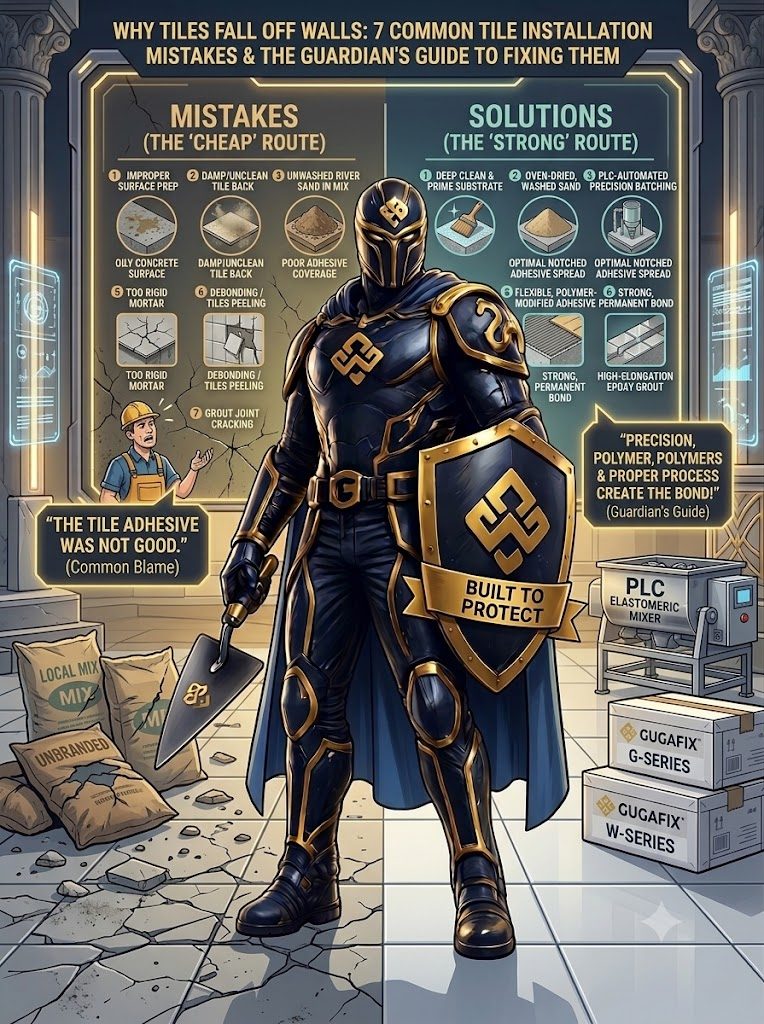
🛡️ Guardian’s Job-Site Insight "Don't let a contractor tell you that soaking vitrified tiles in water makes traditional cement stick. Vitrified tiles don't absorb water! Soaking them does absolutely nothing to help raw cement grip. To bind glass-dense vitrified tiles safely, you need the polymer-power of a dedicated adhesive like the Gugafix G-Series."
Save Money and Time with Gugafix
While a bag of sand-cement mortar might look cheaper on paper, it requires far more material, creates massive on-site wastage, takes days to cure, and carries a high risk of future repair costs.
Using Gugafix Tile Adhesives allows your tilers to work faster, use less material, and create flawless, hollow-free surfaces that last a lifetime. Protect your premium flooring investment with the bond it actually deserves.


Comments