

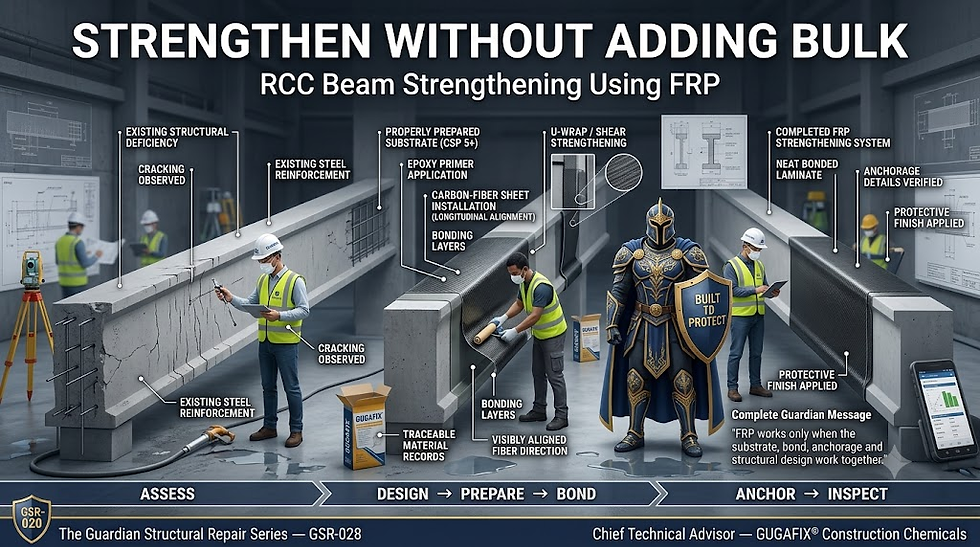
GSR-028RCC Beam Strengthening Using FRP: Principles, Applications and Limitations. The Guardian Structural Repair Series
By The Guardian
Chief Technical Advisor — GUGAFIX® Construction Chemicals
Introduction
When an RCC beam develops inadequate load-carrying capacity, excessive cracking, deterioration, or increased loading requirements, strengthening may be necessary.
Concrete jacketing and steel plate strengthening are established methods, but they can increase member size, add considerable dead load, require extensive access and involve significant site work.
Fiber Reinforced Polymer (FRP) strengthening provides another approach.
FRP systems use high-strength fibers—commonly carbon, glass or aramid fibers—embedded in a polymer matrix. When properly designed and bonded to an existing structural member, the system can contribute additional tensile or shear capacity without substantially increasing the dimensions or weight of the member.
But FRP is not a universal strengthening solution.
Its effectiveness depends on the existing concrete, surface condition, bond, anchorage, load-transfer mechanism, environmental exposure, fire requirements and—most importantly—the structural design.
The Guardian's Philosophy “I don't sell construction chemicals. I help people build stronger, safer, and longer-lasting structures.”
1. What Is FRP Structural Strengthening?
FRP strengthening involves externally installing fiber-reinforced polymer materials onto an existing structural member.
The system generally consists of:
High-strength reinforcing fibers
A polymer resin or matrix
Primer or substrate preparation materials where required
Saturating/bonding resin
Protective or finishing layers where specified
Mechanical anchorage or additional detailing in certain applications
The fibers provide the primary reinforcement, while the polymer matrix holds and transfers stresses between the fibers and the structural substrate.
Unlike conventional steel reinforcement, FRP does not behave in exactly the same way as steel.
Therefore, FRP design should not simply be treated as “sticking extra reinforcement onto concrete.”
2. Why Is FRP Used for RCC Strengthening?
FRP can be attractive when the strengthening system needs to provide additional capacity while keeping additional weight and dimensional changes low.
Some potential advantages include:
Low added weight
FRP systems are lightweight compared with steel plates or concrete jacketing.
This can be particularly useful where additional dead load needs to be minimized.
Minimal increase in member dimensions
Externally bonded FRP can generally be installed without creating the substantial increase in beam or column dimensions associated with jacketing.
Rapid installation
Depending on the system and site conditions, FRP installation can require considerably less structural alteration than conventional strengthening methods.
Corrosion resistance
FRP itself does not corrode like conventional steel.
However, this does not mean the entire strengthening system is automatically immune to environmental degradation. Resin selection, detailing and protection remain important.
Difficult-access applications
The low weight and flexibility of many FRP systems can make them useful where transporting and handling heavy steel plates is difficult.
3. How Does FRP Strengthen an RCC Beam?
The answer depends on what deficiency is being addressed.
FRP can be configured differently for different structural objectives.
Flexural Strengthening
For a beam requiring additional flexural capacity, FRP strips or sheets may be installed along the tension face.
The FRP acts as additional tensile reinforcement.
The load-transfer mechanism is therefore critical.
The strengthening system must develop adequate interaction with the existing concrete through the adhesive/bonding system and appropriate detailing.
Shear Strengthening
FRP can also be installed around beam webs or in U-wrap/configurations designed to improve shear resistance.
The exact arrangement depends on:
Existing reinforcement
Beam geometry
Concrete condition
Shear demand
Anchorage requirements
Accessibility
FRP shear strengthening therefore requires engineering design rather than simply wrapping the beam.
4. FRP Strengthening Is a Bonded System
This is one of the most important points for site engineers.
An FRP system cannot perform as designed if the load cannot be effectively transferred between:
Existing concrete → bonding interface → FRP system
A high-strength FRP material does not compensate for a weak or poorly prepared substrate.
If the concrete surface is:
weak,
contaminated,
dusty,
delaminated,
cracked beyond acceptable limits,
affected by active deterioration,
then the substrate condition must be addressed before strengthening.
The Guardian's Technical Tip
Never judge an FRP strengthening system only by the tensile strength printed on the FRP datasheet.
The performance of the complete strengthening system depends on the substrate, bond, installation quality, anchorage and structural design.
5. Surface Preparation Is Critical
Before FRP installation, the existing concrete surface should be assessed and prepared according to the engineered strengthening system.
Typical preparation may include:
Removing loose and deteriorated concrete
Repairing damaged areas
Removing contaminants
Exposing a sound concrete substrate
Treating reinforcement corrosion where required
Correcting unsuitable surface irregularities
Achieving the specified surface profile
Ensuring appropriate cleanliness and dryness/moisture condition for the selected resin system
The exact preparation requirements must follow the specified FRP system and manufacturer's technical documentation.
FRP should strengthen sound concrete—not conceal defective concrete.
6. FRP Does Not Replace Structural Assessment
Before strengthening begins, engineers need to understand why the beam requires strengthening.
Possible causes include:
Increased imposed loads
Change of building use
Insufficient original design
Structural deterioration
Reinforcement corrosion
Construction deficiencies
Seismic strengthening requirements
Modification of the building
Loss of structural capacity
A strengthening design should therefore begin with assessment.
The engineer should establish:
Existing condition → Existing capacity → Required capacity → Deficiency → Strengthening strategy
Only then should the appropriate strengthening system be selected.
7. Important FRP Design Considerations
Several factors influence whether FRP is suitable.
Existing concrete strength
FRP relies heavily on the existing substrate for effective load transfer.
Weak concrete may limit the achievable strengthening contribution.
Bond and debonding
The FRP may have very high tensile strength, but premature debonding can prevent that strength from being fully developed.
Anchorage
Some strengthening arrangements may require additional anchorage or detailing to develop the intended capacity.
Existing reinforcement
The engineer must understand the existing reinforcement arrangement and its contribution to the member.
Failure mode
Strengthening should not simply increase one capacity while creating an undesirable alternative failure mechanism.
Serviceability
Crack widths, deflection and other serviceability requirements may also need consideration.
Environmental exposure
Temperature, moisture, chemicals and other environmental conditions can affect the performance and durability of the complete system.
Fire performance
This deserves special attention.
Polymer-based FRP systems can have significantly different high-temperature behaviour from conventional steel reinforcement.
Therefore, fire resistance must be considered separately rather than assumed from the structural strengthening capacity at normal temperature.
8. Where FRP May Be Particularly Useful
FRP strengthening can be considered for applications such as:
RCC beam flexural strengthening
RCC beam shear strengthening
Column confinement and strengthening
Slab strengthening
Seismic strengthening
Strengthening following changes in structural loading
Rehabilitation where additional structural weight is undesirable
Certain strengthening situations with restricted access
The actual suitability must always be established through structural assessment and design.
9. Where FRP May Not Be the Best Solution
FRP is powerful—but it has limitations.
It may be unsuitable or require additional measures where:
The concrete substrate is severely deteriorated
A strengthening layer cannot compensate for fundamentally unsound concrete.
Fire resistance is a major constraint
Additional fire-protection measures or alternative strengthening methods may be necessary.
Anchorage is difficult
Certain geometries and failure modes may make adequate load transfer difficult.
The structural deficiency is extensive
A larger intervention such as concrete jacketing, steel strengthening or partial reconstruction may be more appropriate.
Site conditions are unsuitable
Temperature, moisture, contamination or other environmental conditions can affect resin application and curing.
The strengthening objective is not clearly established
Applying FRP without understanding the actual structural deficiency is not a proper strengthening strategy.
10. FRP vs Steel Plates vs Concrete Jacketing
FRP should be selected as part of an engineering comparison—not because it is simply “modern.”
Factor | FRP | Steel Plates | Concrete Jacketing |
Added weight | Low | Moderate | High |
Increase in member size | Generally low | Generally low | Significant |
Corrosion of strengthening material | FRP itself does not corrode | Requires corrosion protection | Reinforcement requires protection |
Installation weight | Low | High | High |
Site disruption | Generally lower | Moderate | Higher |
Fire considerations | Requires careful assessment | Generally favourable compared with polymers | Generally favourable |
Bond/interface | Critical | Critical | Critical |
Design requirement | High | High | High |
Best suited to | Targeted strengthening where low weight is valuable | High-strength plate strengthening | More substantial strengthening/rehabilitation |
There is no single winner.
The correct choice depends on the existing structure and the engineering objective.
11. The Biggest Mistake: Choosing FRP Before Diagnosing the Problem
A common mistake in structural rehabilitation is starting with the material:
“We need FRP.”
The better question is:
“What structural deficiency are we trying to correct?”
Only after identifying the deficiency should the engineer evaluate:
FRP
Steel plates
Concrete jacketing
Additional reinforcement
Other strengthening systems
Partial reconstruction
Material selection should follow structural diagnosis—not replace it.
12. Site Quality Control for FRP Strengthening
Even a correctly designed FRP system can fail through poor installation.
The site team should control:
Surface preparation
Concrete repair
Surface cleanliness
Material identification and batch records
Resin mixing
Application temperature
Pot life
Fiber orientation
Wrinkles and air entrapment
Overlaps
Anchoring details
Curing
Protective coating where specified
Final inspection and documentation
Photographic records and material traceability are also valuable for structural rehabilitation projects.
13. The Guardian's Site Check
Before accepting an FRP strengthening installation, ask:
1. Has the structural deficiency been clearly identified?
2. Has the existing concrete been assessed?
3. Is the substrate sound enough for the proposed strengthening system?
4. Has the surface been prepared according to the specification?
5. Is the correct FRP system being used?
6. Are fiber direction and placement correct?
7. Are bonding and anchorage details properly executed?
8. Has curing been completed as required?
9. Have environmental and fire requirements been addressed?
10. Has the completed strengthening been inspected and documented?
If these questions cannot be answered confidently, the strengthening work should not simply be accepted because the FRP material itself has a high published strength.
Conclusion
FRP strengthening can be an efficient and technically sophisticated method for upgrading existing RCC structures.
Its major attraction is the ability to introduce additional structural reinforcement with relatively little added weight and limited increase in member dimensions.
But FRP is not a shortcut around structural engineering.
Its success depends on the complete system:
Assessment + Design + Sound Concrete + Surface Preparation + Bond + Anchorage + Correct Installation + Quality Control
When these elements work together, FRP can become a valuable tool in structural rehabilitation.
When they are ignored, even a premium FRP material may fail to deliver the intended structural benefit.
The Guardian's Final Advice
“A strengthening material is only as effective as the structure, interface and engineering that allow it to work.”
About The Guardian
The Guardian — Chief Technical Advisor, GUGAFIX® Construction Chemicals
“I don't sell construction chemicals. I help people build stronger, safer, and longer-lasting structures.”
Knowledge Builds Stronger Structures.
/blog/rcc-beam-strengthening-using-frp


Comments