

The Guardian Tile Adhesive Series— GTA-017 Back-Buttering Large-Format Tiles: When and Why Is It Required?
By The Guardian – Chief Technical Advisor,
GUGAFIX® Construction Chemicals
Introduction
Large-format tiles have changed modern flooring and wall applications. Larger porcelain, vitrified and stone tiles can create a premium appearance, but their installation also requires greater attention to adhesive coverage.
One technique frequently discussed in professional tile installation is back-buttering.
But what exactly does it mean?
When is it useful?
Is it required for every large tile?
And does back-buttering simply mean applying "more adhesive"?
The answer to all four questions is no.
Back-buttering is an installation technique used to help achieve the required adhesive contact between the tile and substrate. It should be applied according to the tile, substrate, adhesive and project requirements.
1. What Is Back-Buttering?
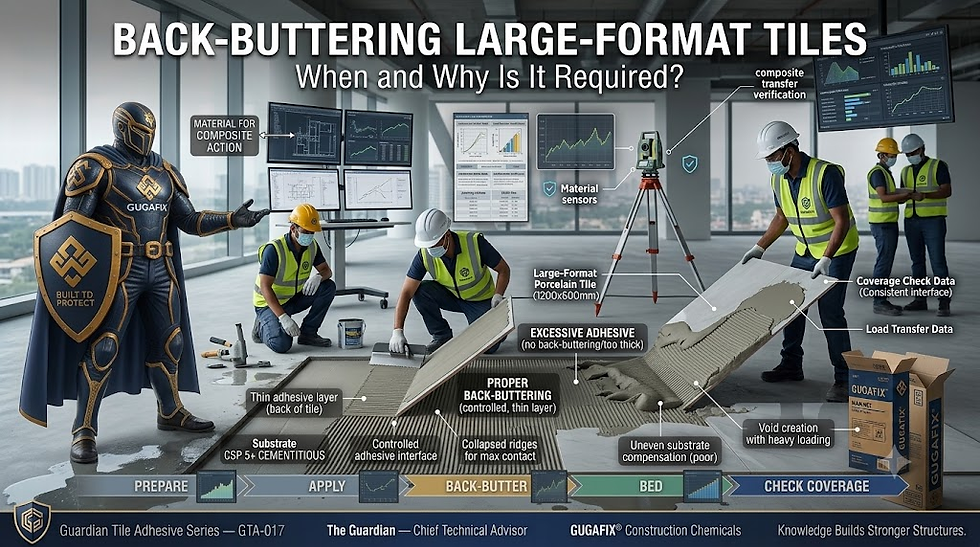
Back-buttering means applying a layer of tile adhesive to the back of the tile in addition to applying adhesive to the substrate.
The objective is to improve contact between the tile and adhesive and help achieve the required coverage.
A typical installation may therefore involve:
Adhesive on prepared substrate
Adhesive applied to tile back
↓
Tile properly bedded into adhesive
The objective is contact and coverage, not simply increasing adhesive consumption.
2. Why Is Back-Buttering Used?
Large-format tiles can be more demanding to install because their larger surface area makes it more difficult to achieve consistent contact across the entire tile.
Back-buttering can help where the installation requires improved adhesive transfer and coverage.
It can be particularly relevant when dealing with:
Large-format porcelain tiles
Large vitrified tiles
Certain natural stone tiles
Tiles with textured or irregular backs
Applications where high coverage is required
However, the exact requirement depends on the installation conditions.
3. Does Every Large Tile Require Back-Buttering?
Not automatically.
This is an important distinction.
Tile size alone should not determine the entire installation method.
The installer should consider:
Tile dimensions
Tile-back profile
Substrate flatness
Adhesive characteristics
Location
Exposure
Required coverage
Installation method specified by the manufacturer
Applicable project requirements
A large tile installed on a properly prepared substrate with the correct adhesive and application technique may have very different requirements from another large tile installed under different conditions.
4. Back-Buttering Is Not a Levelling Method
One of the most common misconceptions is that back-buttering can be used to compensate for an uneven substrate.
It should not.
If the substrate has significant irregularities, the correct solution is to address the substrate before tile installation.
Back-buttering is intended to contribute to proper adhesive contact.
It is not a substitute for substrate preparation.
5. How Should Adhesive Be Applied to the Tile Back?
The adhesive applied to the back of the tile should form an appropriate, controlled layer.
The objective is not to create random thick patches.
The installer should avoid:
Large lumps of adhesive
Uncontrolled thickness
Air pockets
Inconsistent application
Contamination of the tile back
The adhesive should be applied in a manner consistent with the selected installation system and manufacturer's recommendations.
6. The Direction of the Adhesive Ridges Matters
When adhesive is combed on the substrate, consistent ridges help the tile bed properly into the adhesive.
For professional installations, the adhesive should be applied using an appropriate notched trowel and technique.
The tile is then placed and moved appropriately to collapse the ridges.
The purpose is to minimise voids and achieve good adhesive transfer.
This is why back-buttering should be considered part of a complete installation method, rather than an isolated action.
7. Back-Buttering and Adhesive Coverage
This is where GTA-013 and GTA-015 become particularly relevant.
The objective is not:
More adhesive = better installation
The objective is:
Adequate adhesive coverage with controlled application.
After installation begins, the installer should periodically lift tiles to verify adhesive transfer.
This is particularly important when installing large-format tiles.
If coverage is inadequate, investigate the cause rather than simply adding more adhesive.
Possible causes include:
Incorrect trowel selection
Poor substrate flatness
Incorrect adhesive consistency
Incorrect application technique
Excessive working area
Adhesive skinning
Insufficient bedding movement
8. Why Voids Beneath Large Tiles Matter
Large tiles can experience stresses from:
Foot traffic
Point loads
Temperature changes
Substrate movement
Building movement
Significant voids beneath tiles can create areas with reduced support.
Depending on the application, this can increase the risk of:
Tile cracking
Tile breakage
Debonding
Edge damage
Hollow-sounding areas
Proper adhesive coverage therefore becomes a major quality-control consideration.
9. Back-Buttering Is Not "Double Adhesive"
This is another common misunderstanding.
Back-buttering does not mean:
"Put a thick layer of adhesive on the floor and another thick layer on the tile."
That approach can lead to unnecessary adhesive consumption and uncontrolled thickness.
Instead, the installation should be designed so that the adhesive layers work together to achieve the required contact.
The final adhesive bed should remain within the product's specified application parameters.
10. Large-Format Tiles Require Better Substrate Preparation
Back-buttering cannot compensate for poor substrate flatness.
Before installing large-format tiles, check:
Flatness
Surface strength
Cleanliness
Moisture condition where relevant
Existing cracks or defects
Surface contamination
Compatibility with the adhesive
A large tile can make substrate irregularities more difficult to accommodate.
The flatter the substrate, the more controlled the adhesive installation becomes.
11. Don't Allow the Adhesive to Skin Over
Open time is critical.
As discussed in GTA-014, tile adhesive has a defined open time under specified conditions.
If the adhesive surface begins to form a skin before the tile is installed, proper contact can be compromised.
Back-buttering does not automatically solve this problem.
The installer should:
Work within the appropriate open time
Avoid spreading excessive areas at once
Monitor environmental conditions
Remove and replace unsuitable/skinned adhesive where necessary
12. Back-Buttering and Tile Handling
Large-format tiles require careful handling.
Improper handling can cause the tile to touch the adhesive unevenly or trap air beneath parts of the tile.
The tile should be placed carefully and bedded appropriately.
For very large or heavy tiles, proper lifting and positioning equipment may also be appropriate depending on the site.
13. Back-Buttering Natural Stone
Natural stone deserves additional consideration.
Stone varies in:
Porosity
Density
Weight
Back profile
Moisture sensitivity
Colour sensitivity
The adhesive should therefore be selected according to the particular stone and application.
As discussed in GTA-008, the choice between grey and white adhesive can also matter for certain natural stones.
Back-buttering should be incorporated only when appropriate for the stone and adhesive system.
14. Back-Buttering on Walls
Large-format wall tiles can present additional installation challenges because gravity acts on the tile before the adhesive has developed sufficient initial hold.
The installer therefore needs to consider:
Adhesive classification
Tile weight
Tile dimensions
Substrate
Slip resistance
Installation sequence
Mechanical support where necessary
Manufacturer's recommendations
Back-buttering may assist coverage, but it does not replace an adhesive with the required performance characteristics.
15. Common Back-Buttering Mistakes
Mistake 1: Assuming every large tile automatically requires thick adhesive
Correct approach: Follow the installation requirements and product instructions.
Mistake 2: Using back-buttering to level the substrate
Correct approach: Prepare the substrate first.
Mistake 3: Applying random blobs of adhesive
Correct approach: Apply adhesive in a controlled manner.
Mistake 4: Ignoring the adhesive's application thickness
Correct approach: Stay within the manufacturer's specified range.
Mistake 5: Never checking coverage
Correct approach: Periodically lift installed tiles and inspect transfer.
Mistake 6: Working over skinned adhesive
Correct approach: Respect open time and environmental conditions.
Mistake 7: Assuming more adhesive automatically means stronger bonding
Correct approach: Aim for appropriate coverage and correct installation.
The Guardian's Site Check
Before installing large-format tiles, ask:
1. Is the substrate sufficiently flat?
2. Is the selected adhesive suitable for the tile and application?
3. Is the correct trowel being used?
4. Is back-buttering appropriate for this installation?
5. Is the adhesive within its working/open time?
6. Is the tile being properly bedded?
7. Is adequate adhesive coverage being achieved?
8. Is the final adhesive thickness within the product requirements?
The Guardian's Technical Tip
"Back-buttering is not about using more adhesive. It is about achieving better contact."
The professional installer should always think in terms of:
Coverage → Contact → Support → Performance
rather than simply:
More adhesive → Better installation
The Guardian's Advice
Large-format tiles demand greater discipline.
A successful installation depends on the complete system:
Sound substrate
↓
Correct adhesive
↓
Correct trowel
↓
Controlled application
↓
Back-buttering where appropriate
↓
Proper tile bedding
↓
Required coverage
The technique should be adapted to the specific tile and installation rather than applied as a universal rule.
Conclusion
Back-buttering can be an important technique for achieving appropriate adhesive contact, particularly in demanding large-format tile installations.
But it should not be treated as a compulsory step for every tile, nor as a method for correcting an uneven substrate.
The professional approach is to consider the tile, substrate, adhesive, installation conditions and required coverage together.
When properly executed, back-buttering can contribute to a more reliable tile installation.
But remember:
"The purpose of back-buttering is not to increase adhesive consumption. The purpose is to achieve the contact the installation requires."
The Guardian's Philosophy
“I don't sell construction chemicals. I help people build stronger, safer, and longer-lasting structures.”
The Guardian – Chief Technical Advisor
GUGAFIX® Construction Chemicals
Knowledge Builds Stronger Structures
#GUGAFIX #TheGuardian #TileAdhesive #BackButtering #LargeFormatTiles #TileInstallation #TileInstallationGuide #TileAdhesiveCoverage #PorcelainTiles #VitrifiedTiles #NaturalStone #TileContractors #TileInstallers #ConstructionChemicals #BuildingMaterials #CivilEngineering #ConstructionTechnology #BuildStrong #BuildSmart


Comments